
THE FISHERY THAT WOULD NOT STAY MADE
Twin Ponds fisheries history and management review
July 24, 2026 | Living record
LIVING RECORD. This version reflects the historical records, fisheries reports, field observations, and firsthand accounts currently available. It is not final or set in stone. It will be corrected, expanded, or revised when better documentation or additional firsthand information can be verified.
Roads and houses are now the most visible changes around Twin Ponds.
Their effects on the water and fish have not yet been established.
The documented fisheries alterations began decades earlier, but the surviving record is fragmented.
The water had already been dammed and raised. The established fish community had been poisoned. A new brook-trout fishery had been created across the altered water.
To hold that created fishery near its intended condition—a protected sporting water producing abundant, trophy-size Adirondack brook trout—it was repeatedly supported through stocking, fish removal, and professional fisheries work.
The property was sold with the system already transformed and carrying a long history of fisheries intervention. Professional fisheries review has resumed. The questions now are what can still be maintained, whether regular intervention is necessary, what that work accomplishes, and what the record actually supports.
Before the Created Fishery
Before the dam, Upper Twin, Lower Twin, Spring Pond, and the waters spreading through the fen were distinct but connected parts of one headwater system.
Little Duck Pond was separate.
The old map and the 1933 accounts describe a differentiated fishery. Upper Twin held lake trout. Lower Twin held brook trout. Spring Pond was shallow and clear, with white sand visible beneath the water and trout seen below a boat. Little Duck Pond also held brook trout.
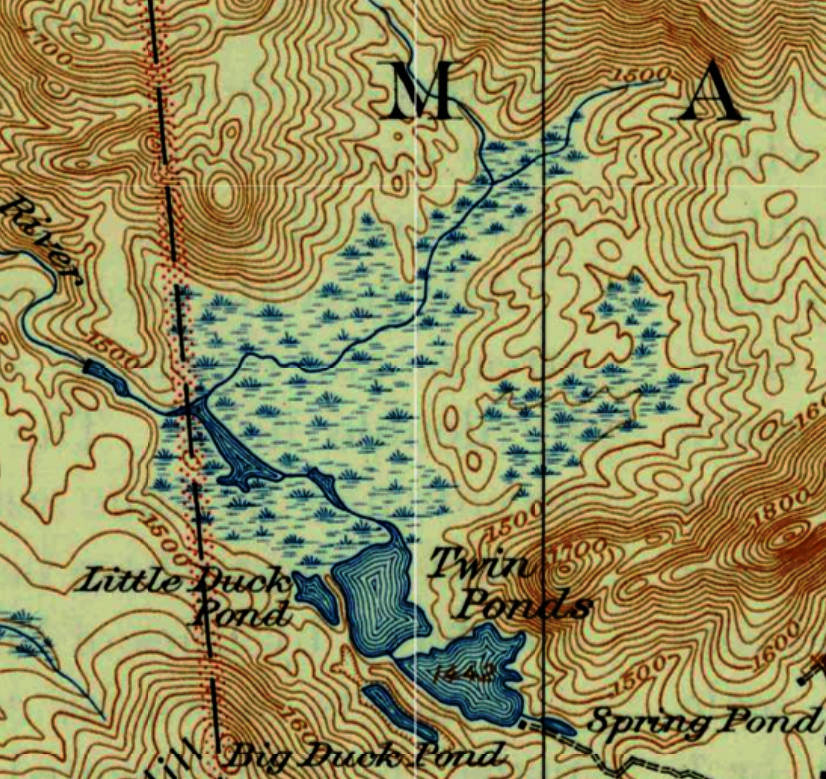
That older water has already been described in The System Asked for Boats. This page follows what happened to the fish community after the dam.
In 1980, a concrete dam was built, raising and expanding the connected waters. Rotenone, a fish poison, was then applied to kill the fish community already present. Beginning in 1982, the enlarged system was stocked and managed as a brook-trout fishery.
The raised water still carries physical evidence of that flooding. Cut stumps and other rooted remains are still visible beneath the new surface, as recorded in The Drowned Line and the Floating Vault. Those drowned remains now provide structure and shadow and can function as fish cover.
Their usefulness as habitat does not erase how they came to be there.
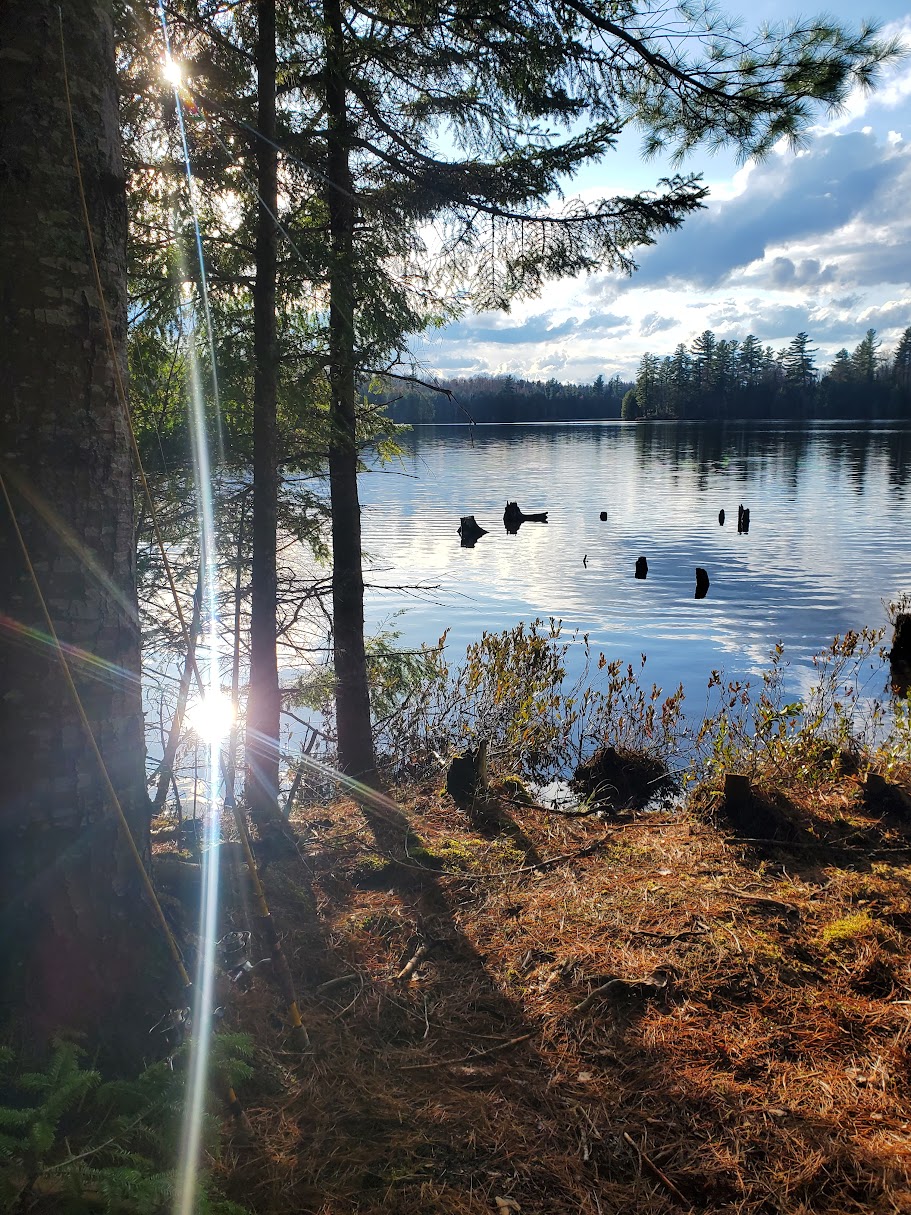
The poison was not selective. Yellow perch, white sucker, brown bullhead, and minnows were among the fishes managers intended to remove. Upper Twin’s lake trout died with them, including fish exceeding sixteen pounds documented in the later fisheries history.
The lake-trout population had produced much larger fish before reclamation. Two separate articles published on the same newspaper page in 1933 described ten- and twelve-pound lake trout as not unusual, scores of fish weighing ten to fourteen pounds, and several fish weighing twenty pounds or better.
Brook trout were already present in Lower Twin. The older account also described trout in Spring Pond and the connected shallow-water system. Wherever the rotenone reached and remained in lethal concentrations, those fish died as well.
The fisheries-management term for that operation was pond reclamation.
At Twin Ponds, the word should not be allowed to imply that the water was returned to an earlier fishery. The treatment poisoned the existing fish community and converted the raised water into a newly created brook-trout fishery.
It was not a restoration of what had been there before.
There had never been an earlier Twin Ponds fishery equivalent to the one being installed.
The Intended Fishery
Beginning in 1982, managers stocked 11,700 yearlings and 13,900 fingerlings of the Temiscamie strain, a Canadian-origin brook-trout strain.
The intention was plainly to establish a brook-trout fishery.
The surviving reports do not establish whether managers expected natural reproduction eventually to sustain it without further stocking, whether continued stocking was part of the original plan, or how long they expected active management to continue.
Young-of-year brook trout were observed along the shoreline in 1983. New Brandon’s later management-history report interpreted them as likely evidence of natural reproduction.
The surviving record does not identify their parents. They could have descended from the 1982 stocking. The record also does not rule out survival of brook trout that had been present before the treatment.
During the 1983 fisheries survey, Brandon Fisheries captured thirty-two pounds of brown bullhead.
The later management history treats that catch as evidence that the rotenone treatment had not eliminated them. The surviving records do not identify where they persisted or how many remained.
A Refuge Within the Treatment
The later report suggests that some bullheads survived in a refuge.
At Twin Ponds, that could mean water where rotenone was diluted, failed to circulate completely, or did not remain at a lethal concentration long enough: groundwater, fen water, floating-mat margins, tributaries, flooded pockets, or other poorly circulated water.
That remains an interpretation. The records establish the outcome, not the exact refuge: bullheads were captured in 1983 and their population rebuilt.
A System Larger Than the Method
Twin Ponds was not a small, single-basin pond. It had a dam-controlled outlet, but behind that outlet lay multiple connected basins and a physically complex headwater system.
For complete removal, the rotenone had to circulate throughout that system, reach a lethal concentration, and remain there long enough to kill every fish.
The question is whether it could do that across the fen and wetland water, groundwater inflows, flooded margins, tributaries, and connected channels.
The original permit, dosage calculations, application maps, outlet-protection measures, and post-treatment verification have not yet been obtained or located. Without them, the planning and application cannot be fully judged.
But the possibility remains that the treatment was overmatched by the physical complexity of the system.
The Same Springs
The springs and groundwater upwellings may now be part of the fishery’s salvation.
They supply cold water and may provide spawning habitat and summer thermal refuge for brook trout. As long as that groundwater remains cold and clean, it helps preserve the conditions the trout require.
That does not mean groundwater contamination is occurring. It means the future quality and quantity of that water will be important to whatever happens next.
The same groundwater that now helps sustain brook trout may also have worked against the rotenone treatment.
Groundwater inflows could have diluted rotenone locally and helped create refuge conditions if the treatment plan did not fully account for them. The water that protects trout now may also have helped some of the earlier fish survive the attempt to kill them.
The Treatment Becomes Maintenance
Brandon Fisheries responded to the surviving bullheads by establishing annual spring-and-fall removal netting. Twin Ponds staff were supplied with trap nets and conducted removals of their own.
By 1984 and 1985, brook-trout condition was described as less than optimal.
In 1986, 6,358 pounds of brown bullhead were removed.
The one-time attempt to convert the fishery had become recurring work. Brook trout were stocked, bullheads were netted out, the water was surveyed, and the work was repeated.
White suckers appeared in the survey record by 1990. Whether they survived the original treatment, entered later, or were introduced has not yet been established.
Current removals are not limited to bullheads and suckers. The nets also capture pumpkinseed, creek chub, and occasional other fishes.
Bullheads, suckers, pumpkinseed, and creek chub do not affect brook trout in the same way. The management issue is not simply that other fishes are present. It is that managers are trying to maintain a brook-trout-dominated fishery within a system where those other species are now established.
When Payment Stopped
Brandon Fisheries’ professional involvement ended abruptly in 1993 because of nonpayment for services rendered.
That is the documented fact.
The surviving reports do not explain the full dispute, who made the decision, or what the owners believed would happen if professional management stopped.
Twin Ponds staff reportedly continued some removal work, but Brandon Fisheries conducted no further surveys, and the duration, frequency, and results of the staff effort are not preserved in the current history.
Stocking later resumed intermittently, but that record is also incomplete.
The surviving management history is internally inconsistent. It identifies intermittent stocking through 2009 and states that no further stocking record exists after that year, but it also contains a reference to a stocking in “fall 2021.” Until the underlying records are found, neither the length of the stocking gap nor the 2021 entry should be treated as fully resolved.
The original stocking records needed to resolve that conflict have not yet been located.
The professional record had broken, but the ecological process continued. Fish did not stop feeding, spawning, competing, and rebuilding their numbers because the management record ended.
The missing years should not be converted into a cleaner history than the surviving evidence supports.
The Same Extraction, in Water
The history resembles another pattern already recorded in The Timber, the Iron, and the Taxonomist.
On land, the receipts remained in the ground: cuts, grades, iron, slag, and land worked for what could be taken from it.
Here, the receipts remain in the water: the dam, flooded margins, a poisoned fish community, a replacement brook-trout fishery, and recurring work undertaken to hold the intended fishery near a selected condition.
The pond system later supported a private guided fishery for trophy brook trout and was eventually sold. The surviving record does not establish the former owners’ motives or the economics of that operation.
It does establish that the physical and ecological consequences outlasted the decisions that produced them. The current owners and association inherited altered water and a fishery with a long history of active support.
Whether that level of support remains necessary is a separate question.
What I Saw Before I Knew the History
Public accounts associated with the Hungry Trout did more than describe Twin Ponds as remote Adirondack water producing wild brook trout.
In the 2016 article Twin Ponds – An Adirondack Brook Trout Preserve, Hungry Trout guide Evan Bottcher described a protected 2,000-acre property surrounding three ponds and producing wild brook trout weighing three to six pounds. He presented the early-1980s work as bringing the water back as an original Adirondack pond supporting nothing but heritage-strain brook trout. Thirty years later, he described Twin Ponds as self-sustaining, free of trout stocking, and carrying a dense reproducing trout population. The article also identified the Hungry Trout as the only outfitter with access to the ponds.
In a 2021 interview, Bottcher again described a family purchasing roughly 2,000 acres containing the pond system in the 1980s. He said their goal was to bring the ponds “back to the original way” and that they intended to reclaim them “not with chemicals or anything like that.” He attributed the work to shoreline dredging, reconstruction of water flow, changes to the dam, and stocking with heritage-strain brook-trout fry.
The surviving fisheries reports tell a materially different history. They document the dam, rotenone used to poison the existing fish community, and brook-trout stocking beginning in 1982.
There is no reason to assume Bottcher knowingly concealed that history. He may have been repeating the account supplied to guides and clients. But the public article and recording establish that the fishery was being explained as a largely nonchemical return toward an original condition and as a protected, self-sustaining trophy brook-trout preserve.
The same interview described a repeat private sporting operation and unusually large brook trout, including fish measuring twenty-one or twenty-two inches and approaching six pounds. Bottcher called the trout wild, mentioned several possible strain histories, and said genetic testing had been discussed but not completed.
In fisheries use, wild can mean naturally reproduced rather than never stocked.
But the word did not show the whole history.
It did not show the dam, the drowned shoreline, the rotenone treatment, the stocking history, the trap nets, or the repeated removal work behind the fishery.
The fish were real. The relative isolation was real. Some or many of the trout may indeed have been naturally reproduced.
But the fishery had still been deliberately created across altered water.
I did not enter the story with any greater understanding.
What first caught my attention at Twin Ponds was not a fish in my net.
It was Spring Pond.
When Chris and I first toured the property, trout were slurping at the surface across Spring Pond. The rises were not confined to one small pocket. They were appearing throughout the water in front of us.
I did not then ask what had lived there before the dam.
I found that out later by reading the old accounts, working through the maps and fisheries reports, and listening to the local history.
At the time, I saw active trout water.
When I began fishing Twin Ponds in 2022, the fishery confirmed that first impression.
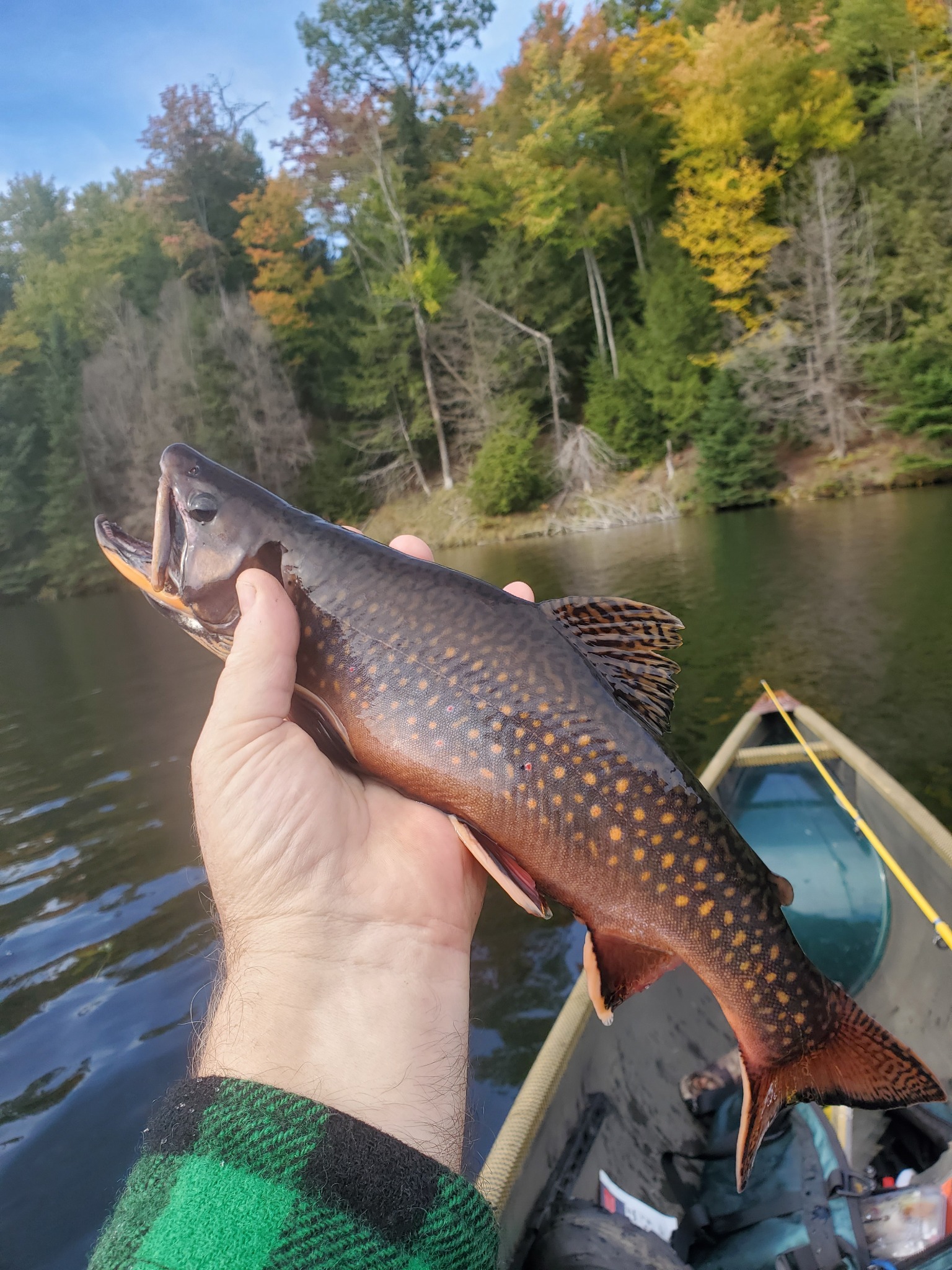
I caught large, well-conditioned brook trout in 2022 and continued catching them through 2026.
The heavily colored fish photographed in October 2022 was not one exceptional catch. It was representative of the quality I was encountering.
From September 29 through October 1, 2023, my friend and colleague Dr. Mike Cole joined me for three days of fishing. Mike is a fisheries biologist, and both of us are benthic taxonomists.
We were not conducting a formal survey, but his journal preserved the fishing in unusual detail.
During his first hour near the Spring Pond entrance, Mike landed at least ten brook trout ranging from approximately twelve inches to more than sixteen inches and called the fishing “a scaled-down version of the Sutton River.”
He recorded catching at least thirty-two brook trout over the weekend. I caught at least seven more during the periods he documented. Most of the pond fish measured between approximately twelve and seventeen inches.
Before the trip, Mike had found the 2016 public article describing Twin Ponds as protected water supporting a dense, naturally reproducing population of large brook trout. That article is now part of the source record. His journal also recorded our understanding at the time that no current stocking was occurring.
That was substantially how I understood it.
We did not yet know the full history of how the present fishery had been created and managed.
I had not learned why the dam had been built, how it had changed the water, which fish had been poisoned, which trout strains had been stocked, or how much removal work had once been required.
I did not ignore that history.
I had not found it yet.
The later reports did not make the fishing we experienced less real. They showed what else had been beneath it.
What neither Mike nor I encountered often were four-to-six-inch brook trout.
That does not prove smaller fish were absent. Our angling may simply have favored larger trout.
But the observation now sits beside New Brandon’s later concern about the younger end of the population.
The Present Management Questions
Twin Ponds is now a privately managed pond system within a residential development. The developer, current property owners, and association do not occupy the same role, but the present owners and association have inherited a fishery shaped by decisions made before they arrived.
The effects of the present development on the water and fish have not been established by the available record. The earlier fisheries alterations are documented.
Professional fisheries review has now returned to the water. The questions are what condition can realistically be maintained, whether regular intervention is necessary, what kind of fishery the community wants, what that work will require, and how the results will be measured.
The present purpose is also different from that of the former private guided operation. Twin Ponds is now a community fishery rather than a commercial sporting preserve selling dependable access to trophy brook trout.
Those are management questions, not an assignment of blame for the earlier decisions that created them.
What the Recent Reports Show
The 2024–2026 surveys describe a brook-trout fishery still capable of producing unusually large fish, but within a remade system where suckers, bullheads, pumpkinseed, and other species are now firmly established.
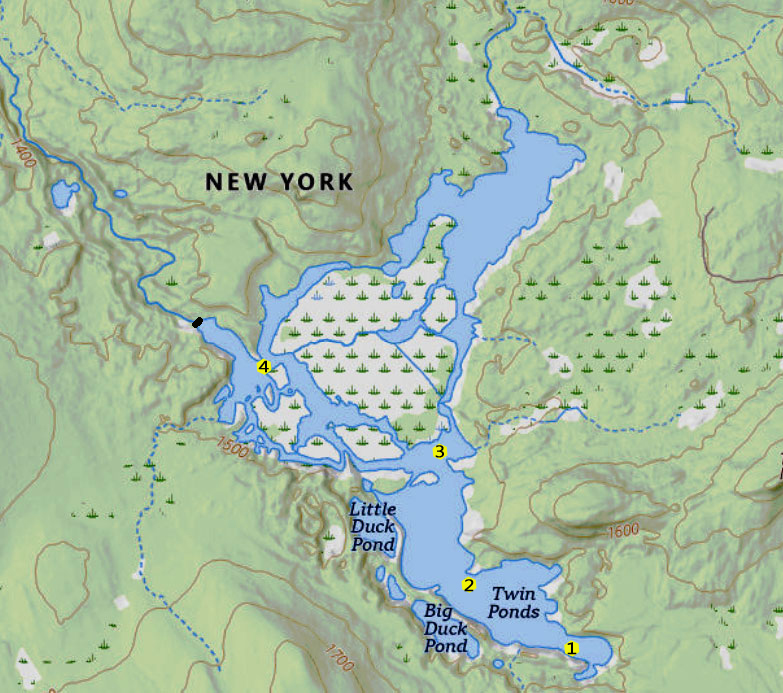
In 2024, the nets found many large adult brook trout but relatively few small ones, alongside a far greater weight of other fish. In 2025, more young trout appeared, likely including fish stocked the previous fall. By 2026, the sample had shifted toward larger trout, suggesting that at least part of that younger group survived and grew. Over the same period, standardized catches of suckers and bullheads fell sharply across the system, although pumpkinseed increased.
The reports show that stocking and removal can alter the abundance and composition of the fish community.
They do not establish that brook trout require annual stocking merely to remain present, or that regular removal is necessary to preserve a meaningful trout fishery.
The available record does not show regular annual stocking during the years immediately preceding the current program. Even with the unresolved 2021 reference, the large brook trout caught in 2022 and 2023 and captured during the 2024 survey demonstrate that the fishery had not disappeared.
The younger end of the population may have been limited. The trout may have been unevenly distributed, and the fishing may have required greater effort.
That is not the same as no fishery.
Stocking supplies additional young brook trout. Removal reduces the weight of established competing fish. Together they may produce greater brook-trout abundance and a more predictable angling experience.
Whether the community needs or wants to purchase that degree of abundance is a different question from whether the work produces measurable results.
What Comes Next
The surviving record is not complete enough to support a final management prescription.
The stocking history contains an unresolved conflict. The duration and results of removal work after professional management ended are not preserved. The original reclamation plans, treatment records, application maps, post-treatment verification, and intended long-term endpoint have not yet been recovered.
Other missing information may remain with former owners, former staff, fisheries consultants, and association records.
Those blank spaces should not be ignored or filled by assumption.
Those questions require access to records, professional answers, community direction, and authority that no individual working alone possesses.
The first move should be to form a fisheries or watershed committee.
That committee should be formally charged to gather and reconcile the missing records, obtain professional answers, identify the costs and responsibilities attached to the present program, define what kind of fishery the community wants, and bring any proposed direction before the owners.
No such committee presently exists.
The long-term objective should not be permanent support for its own sake. It should be to determine whether routine stocking, removal, and professional intervention can eventually be reduced or ended while Twin Ponds continues to support a worthwhile fishery.
After the record has been assembled, the committee would face an immediate choice: continue the present support program to maintain a more abundant and predictable trophy brook-trout fishery, or establish a long interval in which the system is left largely alone.
If the system is left alone, the next major professional survey should come after that interval, when it can determine what persisted without continual correction.
If Twin Ponds still supports a worthwhile self-sustaining fishery, the appropriate next move may be to continue leaving it alone.
If it does not, the committee could then investigate whether the self-sustaining lake-trout fishery removed during reclamation could be restored.
That later possibility rests on the historical record. Upper Twin once supported a reproducing population that regularly produced large fish. The 1933 accounts reported several lake trout weighing twenty pounds or better, and the later fisheries history documented fish exceeding sixteen pounds during reclamation.
This page does not make those later decisions.
It establishes why the first decision is to create the committee capable of filling the record and helping the owners make the later decisions responsibly.
This page will remain open for that answer.
I am not standing outside this history.
If the dam, the poisoning, the created fishery, the sporting operation, the sale, and the later development had not occurred, I might not be here now, looking across this water and keeping the record.
Those events were not equal, and they did not carry the same consequences.
It means I live inside their consequences.
Supporting Material
Supporting Fisheries Data Report
The station-by-station reconstruction is available as a separate printable record.
Open or print: Twin Ponds Standardized Trap-Net Station Comparison, 2024–2026 (PDF)
Source Notes
This page is grounded in the records presently available. Quoted language from interviews follows the reviewed audio transcripts; Mike Cole’s wording follows his contemporaneous written journal.
- Historical geography and fishery: 1930s USGS mapping and the source material assembled for The System Asked for Boats. The mapping and related historical record describe Upper Twin, Lower Twin, Spring Pond, the fen water, and their older connecting channels before the modern flooding.
- 1933 Twin Ponds newspaper accounts: The Malone Farmer, October 4, 1933, page 5. The page contains two separate Twin Ponds articles: “Notable Realty Deal Completed by Malone Firm” and H. A. Kane’s “Reminiscences of Happy Fishing Days at the Twin Ponds.” Together they describe the older differentiated fishery and report numerous large Upper Twin lake trout, including several weighing twenty pounds or better.
- Management history and current surveys: New Brandon Fisheries’ 2023 historical review and water-chemistry work, together with the 2024, 2025, and 2026 fisheries reports and appendices. The surviving history contains an unresolved conflict between a reference to a fall 2021 stocking and the statement that no further stocking record exists after 2009.
- Independent angling record: M. B. Cole, 2023 River Journal: Sept. 29 to Oct. 1 — Twin Ponds, New York. The journal records at least thirty-two brook trout caught by Cole, at least seven more by Nolan during the periods documented, and Cole’s first-hour description of the fishing near the Spring Pond entrance as “a scaled-down version of the Sutton River.”
- Hungry Trout preserve article: Evan Bottcher, Twin Ponds – An Adirondack Brook Trout Preserve, Upstate New York Edition, November 30, 2016. The article describes controlled outfitter access, three-to-six-pound brook trout, the early-1980s creation account, and Twin Ponds as a dense reproducing fishery free of current stocking.
- Hungry Trout public interview: In the Seam with JP Ross Fly Rod Company, Episode 20, interview with Evan Bottcher, 2021. The Twin Ponds discussion begins at approximately 31:42 and continues to approximately 44:55. Bottcher describes the property, a nonchemical reclamation account, shoreline and dam work, heritage-strain fry stocking, uncertain strain history, uncompleted genetic testing, the private guided operation, and unusually large brook trout.
- Related Field Scrawl records: The System Asked for Boats; The Timber, the Iron, and the Taxonomist; The Drowned Line and the Floating Vault; Baseline From the Dock and its Rain Test addendum; The Creel; and the broader 2022–2026 Field Scrawl record.