THE LOON YEAR
An annual record of return, chick, loss, survival, and departure
Date / Moment: Sunday, July 12, 2026, about 1:30–2:00 PM
Location: The Place / Upper Watch
Type: Observation
Species: Common loon (Gavia immer)
It was sometime around 1:30 or 2:00 on Sunday afternoon when I came out to sit at the Upper Watch.
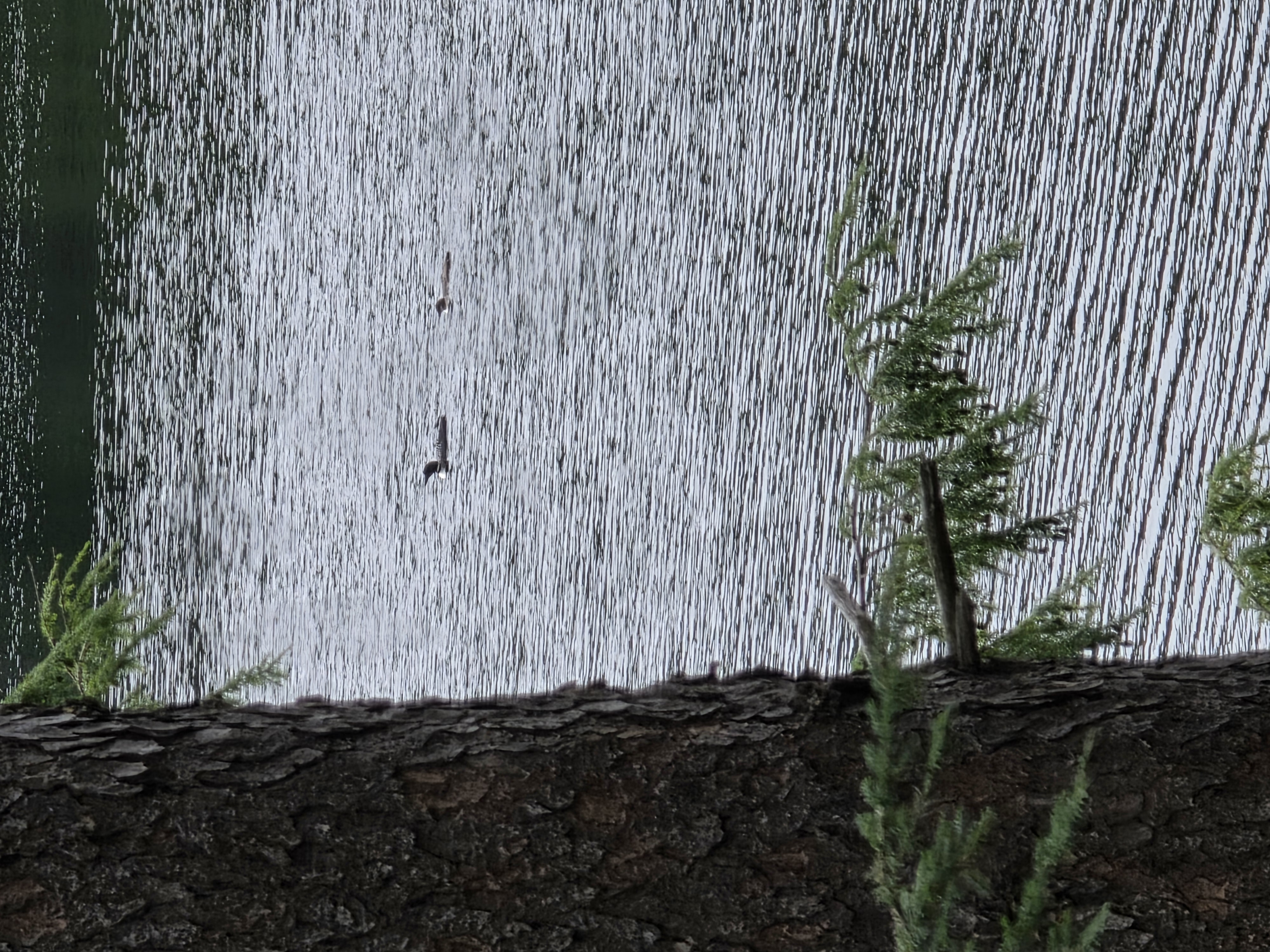
An adult loon and its chick were already halfway across the swath opening, moving from right to left.
It took a little while to get the camera out, find them through the wire rails, and bring them into focus. By then they were nearly gone. I caught one photograph, with the chick almost lost inside the dark streak of an Upper Watch cable.
It is not a particularly good wildlife photograph, but it is a true photograph of how the sighting happened.
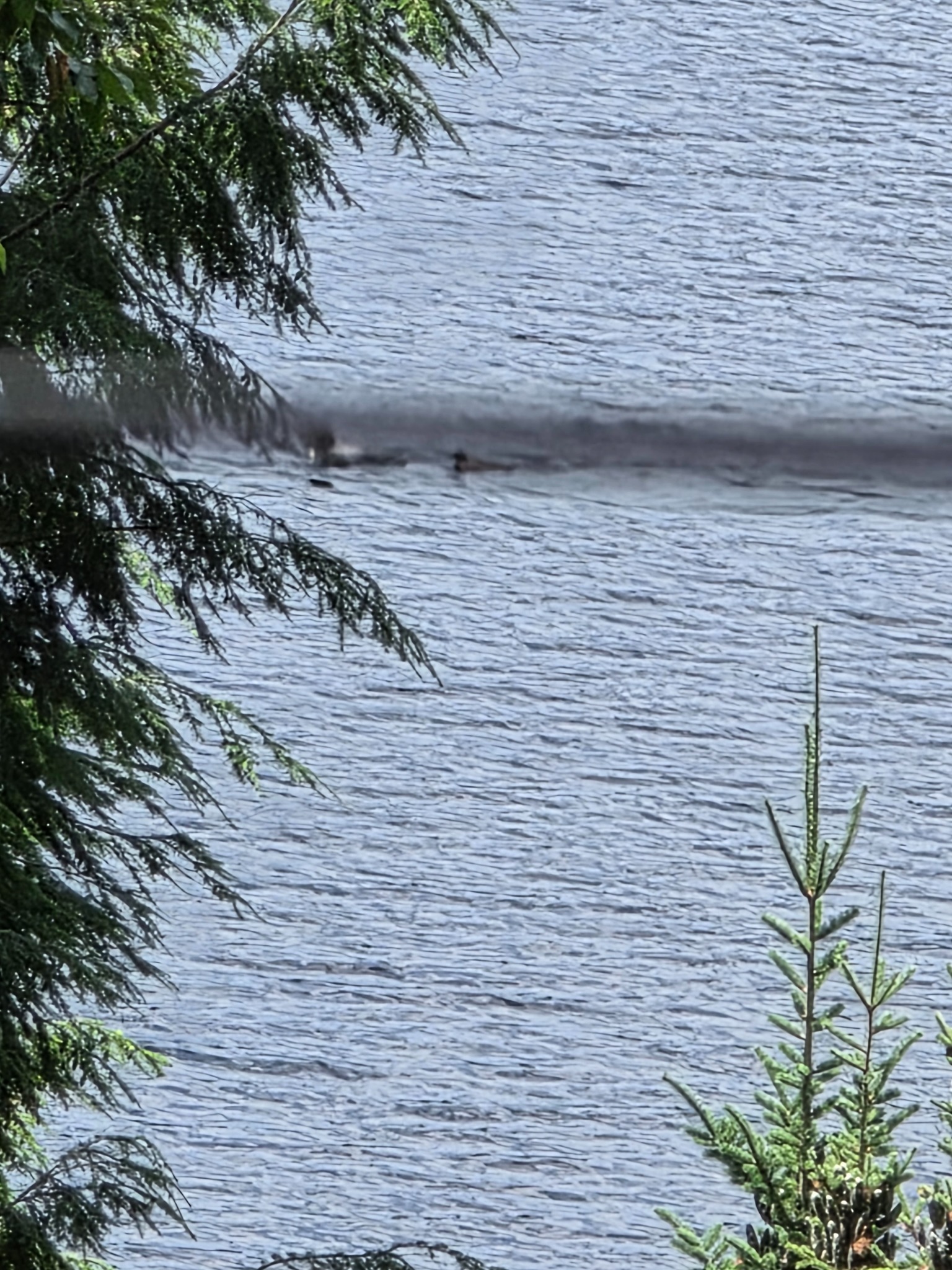
I had photographed the chick more clearly about a week and a half earlier.
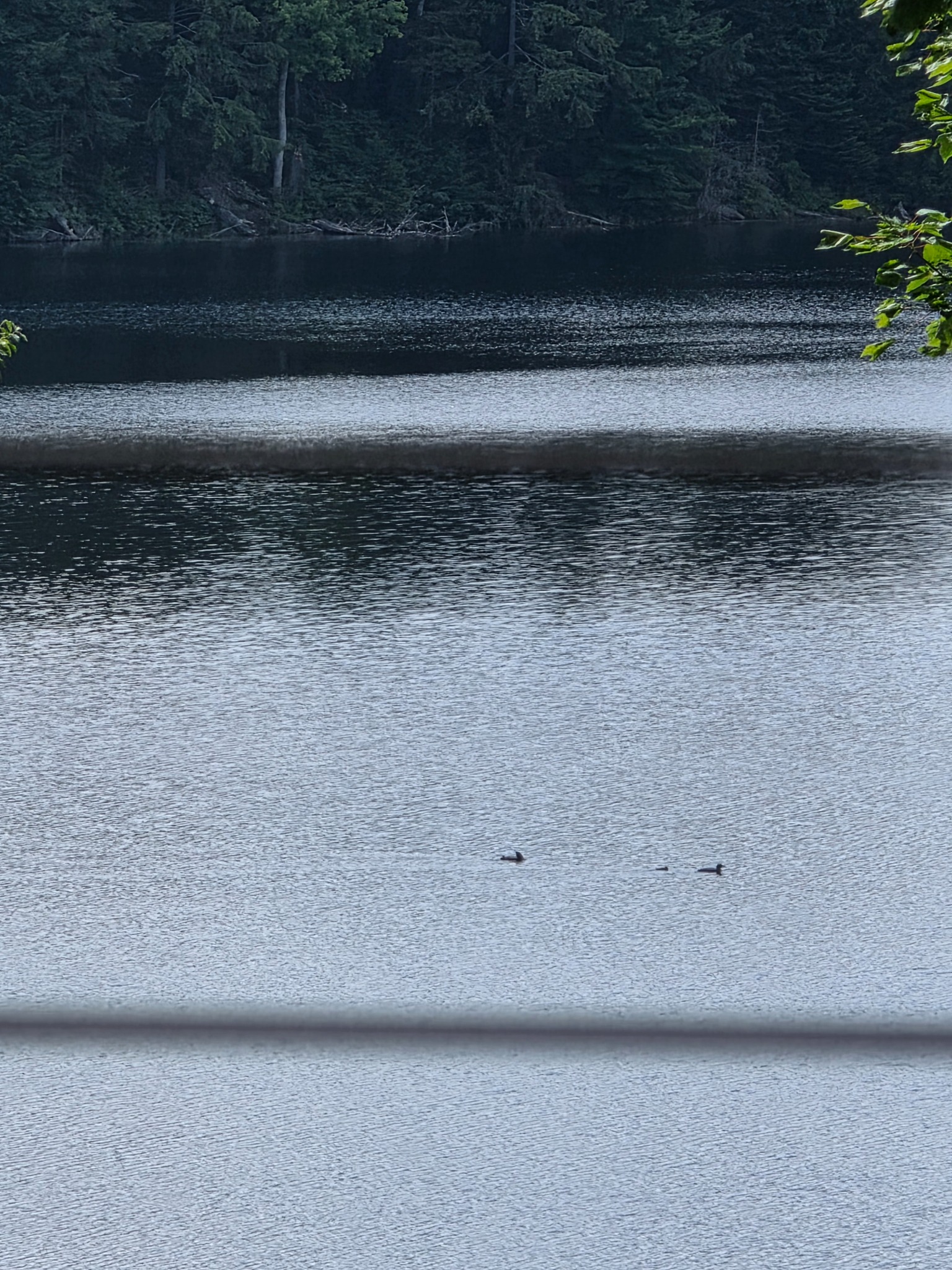
Later, I photographed the pair passing between the trees without the chick in sight. That was what first made me wonder whether an eagle had taken it. During the last several days, the family began passing through the opening more regularly, and today the chick was there again beside the adult.
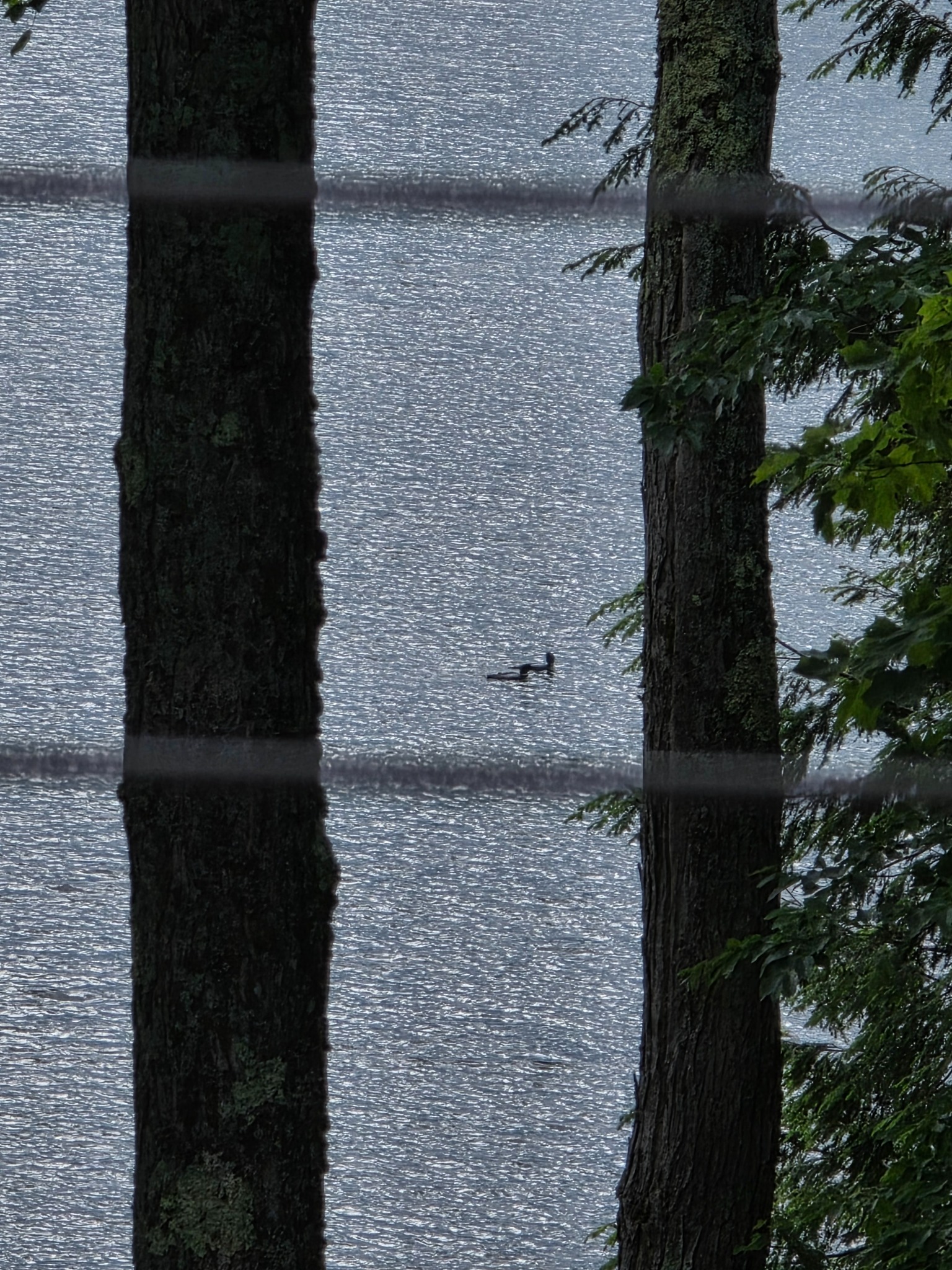
It was a nearly perfect day to sit at the Upper Watch. The temperature was in the mid-seventies, the humidity was low, and broken clouds crossed a blue sky above blue water. The previous two days had been much the same.
The loon and chick crossed the opening, disappeared behind the trees, and left me thinking about my history with loons.
There were no loons that I recall on the lake where I grew up.
My parents had a camp there, and I spent much of my childhood summers on that water. The lake now has a pair that has returned for a number of years, perhaps a decade or longer, but I have no childhood memory of hearing or seeing them.
DDT has crossed my mind, though I have no evidence connecting it to that lake.
What remains is the difference between what is present there now and what I remember then.
My encounters with loons came later and on other waters.
During one spring trip through the Saint Regis Canoe Area, I came fairly close to three, four, perhaps five loons.
They bobbed up and down, faced one another, looked beneath the surface, dove, splashed, and lifted their wings. I thought of it as a spring dance. Whatever the behavior was, they were fully involved in it.
On another Saint Regis trip, probably before I went to Algonquin, I was paddling close along the shoreline when something suddenly moved underwater between my canoe and shore. There was only about ten or twelve feet of water between us.
At first, I did not know what I was seeing. It took a few seconds for my brain to catch up with what had passed through that narrow space.
It was a loon.
One moment I was paddling along the shoreline, and the next a loon had swum underwater almost directly beside me.
The closest encounter came later during a canoe trip in Algonquin Provincial Park.
I had gone swimming. When I surfaced, a loon surfaced only a few yards away.
For a moment, we were both there at water level, much closer than I had ever expected to be to one. I called out to David. My surprise and excitement should still be in the video.
On our final day in Algonquin, as we paddled out, we came upon an asylum of perhaps eight to twelve loons spread across the water.
The loon surfacing beside me while I swam had been an intimate surprise. This was something different: a gathering of birds on the water as the trip was ending.
Chris and I later visited a small loon museum in Saranac Lake. There I saw the structure of the skull and bill and learned how the bill is used not only for fishing but also for defense.
It is a serious instrument.
I learned that a loon can drive the bill upward at an attacker. Seeing the structure of the head and bill made its defensive capacity easy to understand.
Here at the place, loons are no longer an occasional encounter during a trip. They have become part of the year.
Sometimes at night it gets quite noisy.
The local loons call across the ponds, and more distant birds answer from beyond them—the local loons and the distant relatives carrying on in the dark.
One may sound close to the house, another farther down toward the fen and marsh, and another may answer from beyond anything I can see.
At night, the calls make the connected waters seem larger.
I have been told that the waters around the place may support at least three pairs of loons: one pair here and perhaps two more farther down toward the fen and marsh.
I believe there is at least one additional pair. I have seen other birds and heard loons calling back and forth from different parts of the connected waters. Whether they are separate established pairs or some of the same birds moving through them is harder to know.
They can cover a surprising amount of water without showing themselves.
A loon may dive in one place and surface so far away that I begin searching in the wrong direction. Underwater, it moves more easily than I can follow it from shore.
Taking flight is another matter.
I have always laughed at the effort required for a loon to get airborne. It begins by flapping and kicking, running across the surface of the pond until it develops enough speed for lift.
Even after leaving the water, it cannot always fly directly out. Here, the surrounding trees form a bowl. The loon may circle within the pond and shoreline until it gains enough elevation to clear the trees and leave.
In the water it disappears almost without effort.
In the air it must first earn its way out.
For at least the last three years before this one, the pair here produced a chick that remained on the pond well into the season.
By late summer or early fall, the young bird was no longer the small chick first seen beside an adult. It had grown nearly to adult size. Later, the parents would leave and the young loon would remain behind.
I have watched a young loon stay until nearly ice.
I think of it as being left behind, though that may be too human a description. The adults leave when it is time for them to leave. The young bird remains until it is ready to make its own departure.
The figure I have carried is roughly one surviving chick every other year for a territorial pair.
My own record is of a chick here in each of the last three seasons and now another one this year.
I saw the chicks. I watched the young birds remain late into the season.
That is the record I have.
This year there is another chick.
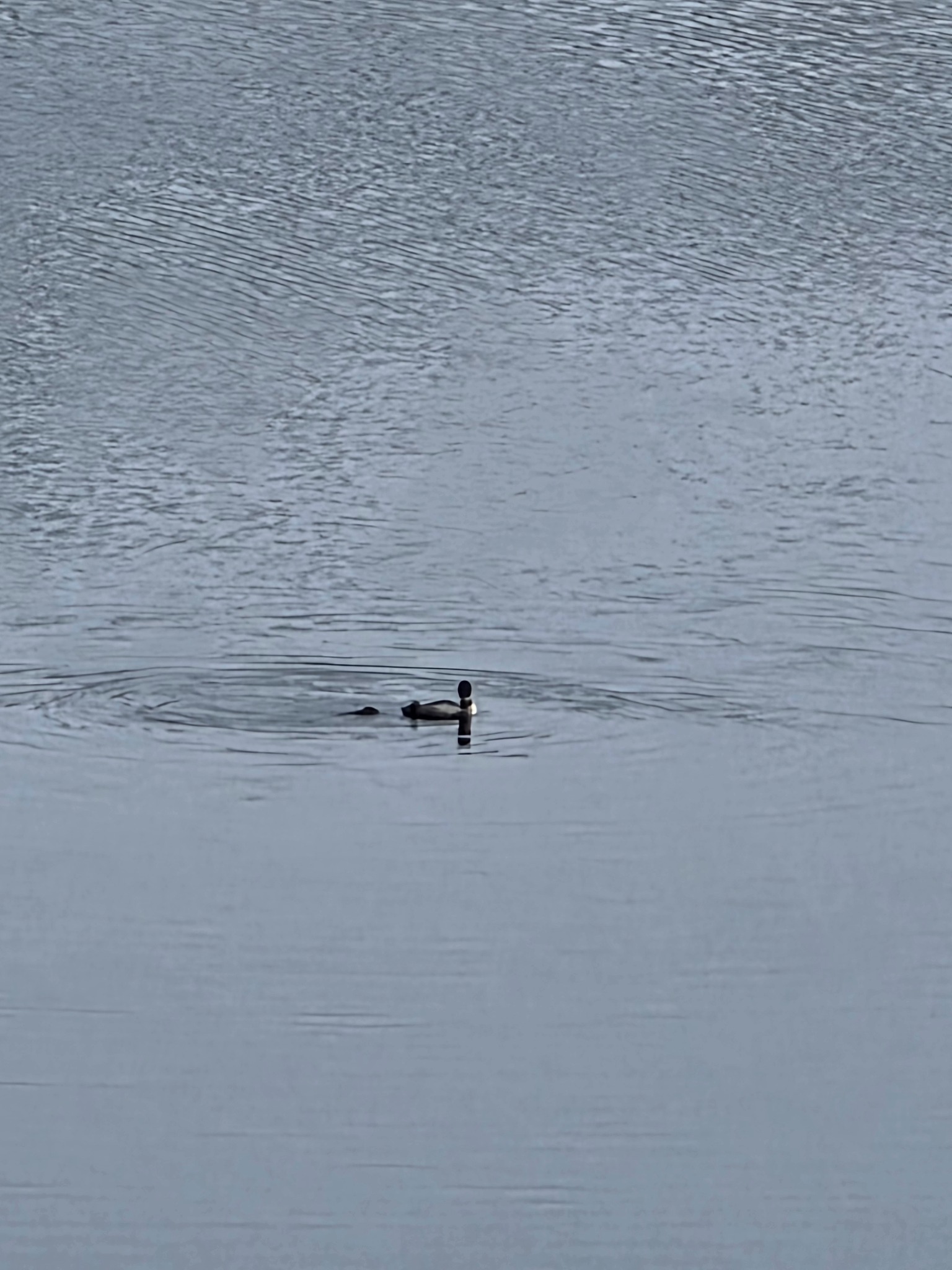
For a while I feared it was gone.
Then it passed through the opening again.
The loon was once something I encountered elsewhere—during a canoe trip, beside a distant shoreline, or unexpectedly while swimming.
Here, it has become an annual presence.
I listen for the calls. I notice when the adults return. I watch for the first appearance of a chick. I notice when I have not seen it for several days and when it passes through again. Later, I notice when the adults are gone and the young bird remains.
That is why the loon needs its own page.
This account can hold the years already remembered: Saint Regis, Algonquin, the loon museum, the calls at night, the chicks here, and today’s hurried photograph through the Upper Watch cable.
Beginning next year, the page can continue through addenda.
Return.
Nesting.
Chick.
Loss.
Survival.
Departure.
Or the absence of any of them.
The page will not assume that every year repeats the one before it.
It will record what passes through the opening.
Still Together
In front of the dock, one adult and the juvenile were swimming in from the left while another adult approached from the right. A short time later, all three remained on the water in front of the lean-to.
I took the group to be the same family I have been following, although this observation alone does not establish the identity of the individual adults. What I could see was two adults and the juvenile together on the pond on August 10.
I have not kept up with the weather and routine pond observations as closely lately. There have simply been too many other things going on around the place.
Retirement is something.