
Back to the Woodpile
The new hip meant changing how I worked for a while. What I wanted was to get back to the work, and to the pleasure I took in doing it.
I had no intention of giving up the work. But some of the ways I had been doing things needed to change.
I started using a chainsaw early, at my parents' Adirondack camp. We cut wood cookies, made foundations, and built small structures. I was learning what a saw could do long before I had much language for leverage and the forces involved.
Years later, a conservation instructor brought attention to something I was already doing. While other students held the saw like luggage, my thumb was wrapped tightly around the upper handle.
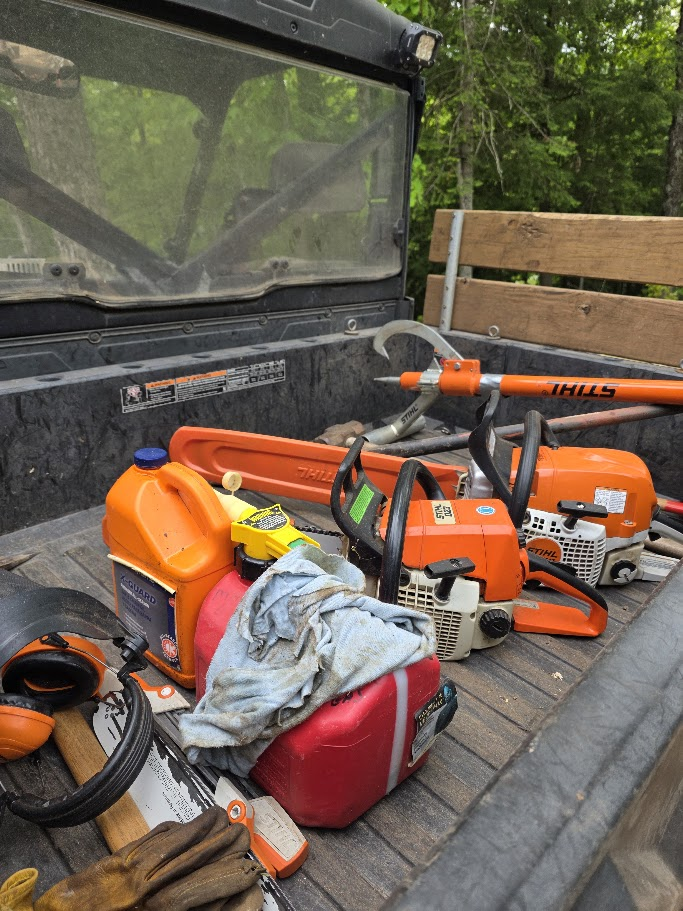
A chainsaw is not a prop. It is a live animal. You either have hold of it or it has hold of you.
Firewood presented another problem. I'd been stacking it in straight rows, using posts, pipes, and cribbing to hold everything in place. It worked until the volume became too much for the supports. One of those stacks came down.
It was more than a nuisance. I had put considerable work into arranging wood that couldn't remain standing without further help.

I decided to try a Holz Haus, a circular wood stack that supports itself through the arrangement of the pieces.
I stripped away the duff and exposed the stony glacial till beneath it. The ground was uneven, but firm. I wanted a base that wouldn't rot beneath the wood.
Then I began building the ring. No pipes or posts to prop up a long wall. The pieces lean and bear against one another, their weight helping hold the stack together.

The split seconds went into the middle, loosely arranged to leave a passage for air. The idea was to let air move through the center while the outer ring held together. Drainage, drying, stability, and getting the wood out again in winter were what I was after.
The work also reminded me that how a tool cuts depends on more than the sharpness of its teeth. I file the chainsaw's guide-bar rails square. Worn rails can cause the saw to pull away from a straight cut. It's a small maintenance job, easily overlooked, but it makes a difference when you're handling a saw for hours.
The wood processed the previous summer was drying. The capped Holz Haus was standing, without the braces and repairs the old row stacks required.
I was still recovering from the hip replacement, but I was splitting and stacking wood again. The way I handled the work had changed, and the new stack was doing what I had hoped.

HOLZ HAUS — SECOND BUILD
DATE: LOCATION: THE PLACE / WOOD STACK
Today was not an all-day wood push.
I worked in sets. Split enough to fill the Polaris, backed it toward the new stack, and added another course to the outer ring. Then I stepped away, did other work, and came back again.
That rhythm seems better for me now.
The rounds are longer this year, many close to twenty-two inches instead of the sixteen or eighteen I used to burn. The larger stove changes the measure.
The hip replacement is still part of the record, but so is the improvement. Splitting, loading, stepping, backing, stacking — not all day, not all at once, but enough to feel the body working and coming back.
Wood moved.
Ring begun.
Body tested.
FIELD RECORD: Second Holz Haus build begun.
EVIDENCE: Outer ring started; longer rounds cut for larger stove; work completed in sets.
CERTAINTY: Observed work record.

