
THE CLIPBOARD RETURNED
I am writing this from the Upper Watch back at the place.
It is about 82 degrees, calm, humid, and overcast. There are darker clouds around, with a chance of a passing thunder shower. The lake is placid. Nothing is moving hard enough to pull me away, so there is time to set down the other part of the Gloucester trip.
The fishing already has its own record.
My younger son gave me a charter fishing trip for my birthday. We went out of Gloucester on Monday and spent most of the day on the water. It was a bluebird day, calm and clear, and we brought fish home.
That part belongs in the Creel.
This is the other record: what appeared afterward, from the hotel balcony, when the fishing was done and the day had moved back onto land.
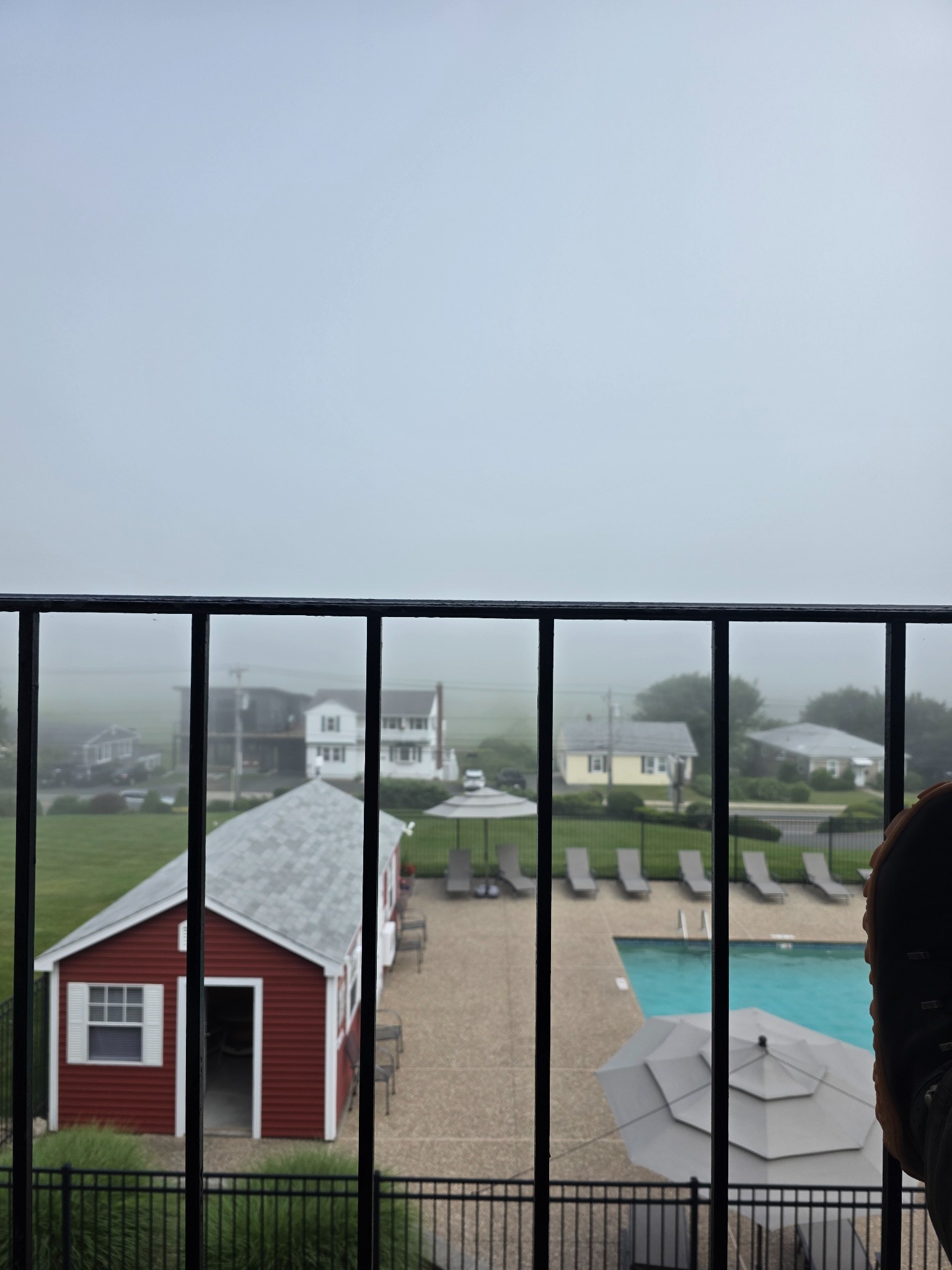
When we first arrived in Gloucester the day before, the view was missing. It looked foggy when we came in, but after some investigation we decided it was not smoke. It was sea fog. We checked into the hotel sometime around mid-afternoon, maybe 2:30 or 3:00. The room was good: kitchenette, balcony, swimming pool below, and supposedly a view out toward the bay. The sea fog withheld that view at first.
After settling in, we sat on the balcony with a drink. Later we went out for seafood. The place had been recommended as a popular joint, generous with food, and mostly fried, which suited me fine. I had haddock, mussels, and shrimp with onion rings and slaw. My son had the same, except with fries and no slaw. We ate our fill.
When we returned, the fog had lifted. The missing ocean came back.
That balcony became a temporary Upper Watch.
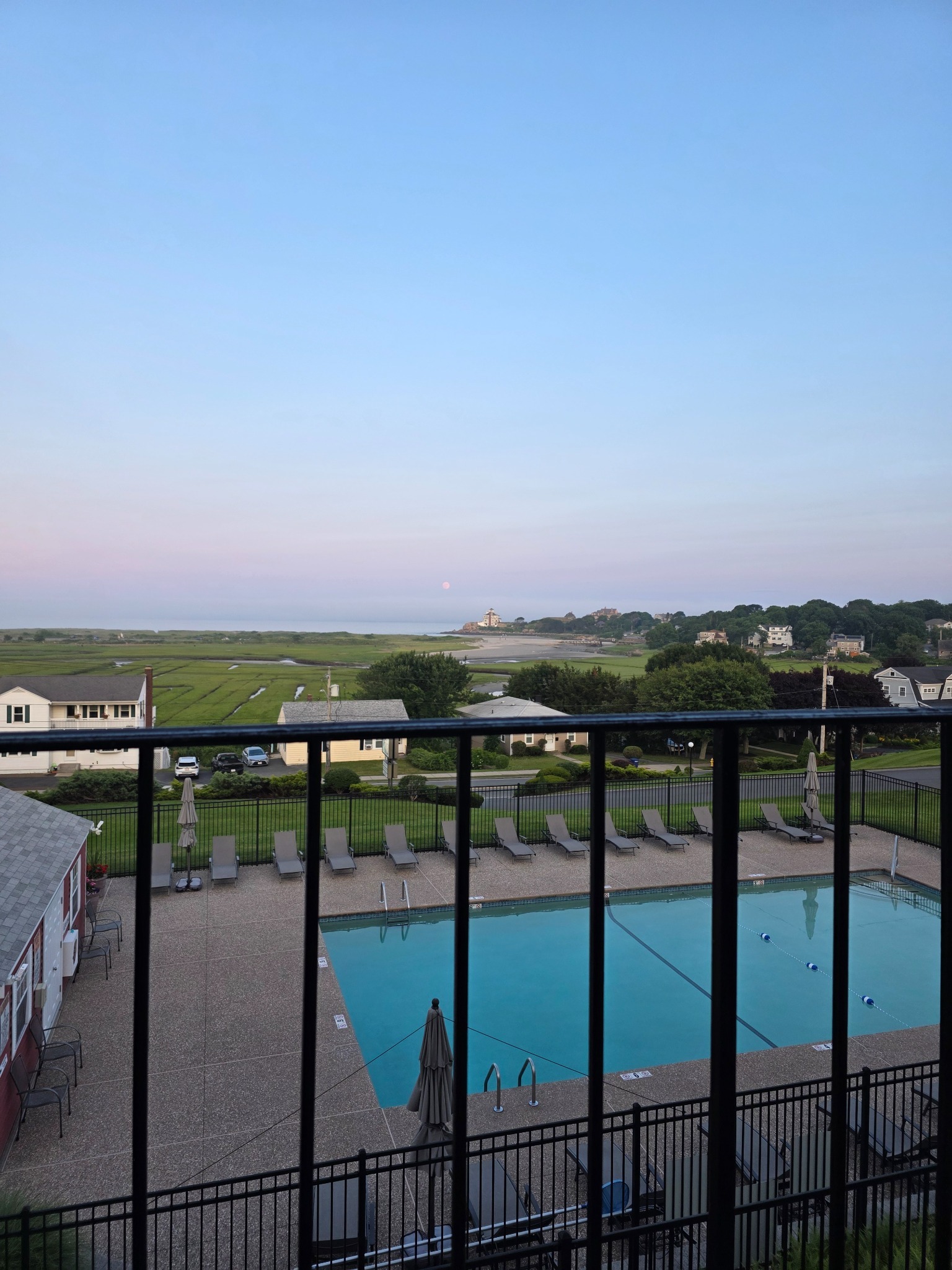
Below us was the pool. Beyond the pool were the marsh, the beach, the bay, the houses, and the rocks. The evening settled in. My son listened to my rambling. I listened to his, though I will not call them confessions. Not really. But a father knows the difference between ordinary talk and the kind of talk that only comes after enough time has passed.
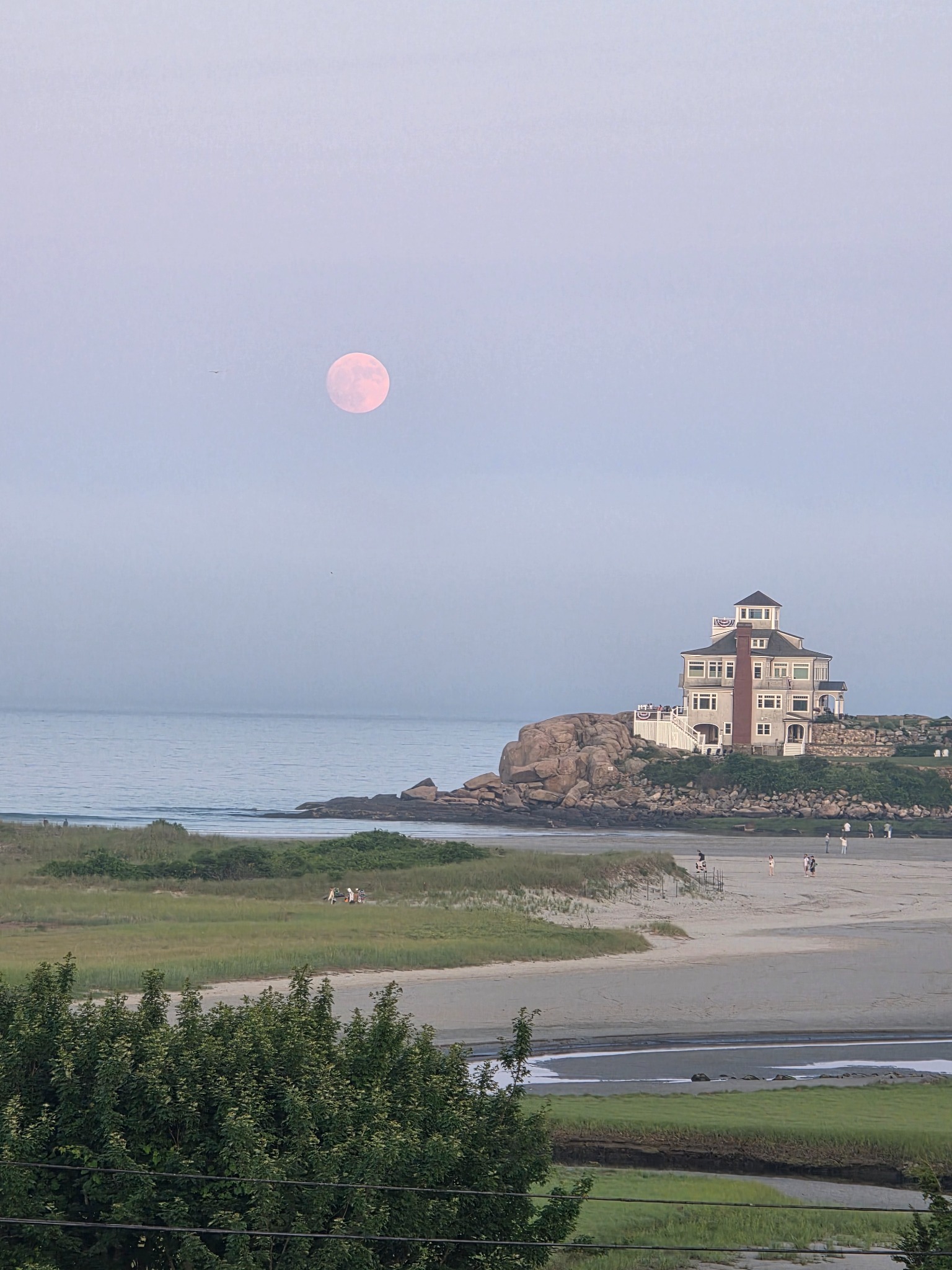
The moon rose out over the water. I pointed out the woman in the moon, not the man. The woman's profile, with the high hair, almost like Wilma Flintstone. Once seen that way, it is hard to unsee.
There were not many people at the pool that first night. Near evening, an attendant arrived with a clipboard. At first I only noticed him doing ordinary pool work. Then the pattern showed itself.
He straightened the lounge chairs. Not casually. Evenly. He wiped moisture from surfaces, including the upper spindles of the fence around the pool. Whether it was webbing holding moisture or just condensation, I do not know. But he wiped it. He moved around the perimeter with purpose. He finished one task and left.
Then he came back.
He closed and tied down the umbrellas. Left again.
Then he returned later and checked the small building at the end of the pool. He went inside for a time, came back out, and departed again. That was probably the last I saw of him that night.
The next morning we fished.
After we got back from the charter, the sun had done its work on me. We were happy, salt-tired, and carrying fish. Back at the hotel, we both took a nap for about an hour and a half.
I woke before my son.
I went out to the balcony alone.
By then the pool had changed. It was busy now. Maybe thirty to forty people, broken into five or six distinct groups. I did not see all of them because I did not want to lean around the corner and make a project of being seen watching. Still, enough of the scene was visible from where I sat.
We were on the second level, facing east from the balcony. The people on the far side of the pool were turned back toward the west and the late sun. They had the advantage of the remaining light, but they also had the glare. Most had sunglasses on. Some lifted a hand over their eyebrows to make enough shade to see what was in front of them. From where I sat, above them and across the pool, I could read the scene more easily than I think they could read me.
The far side of the pool held the sun longest. That was where most of the people had gathered and where most of the lounge chairs had migrated. The near side, on our side, was already losing light. Nobody wanted that side while there was sun left to claim across the water.
But that was not how the chairs had been arranged the night before, after the clipboard attendant finished his work.
A young couple came in and walked to the far left side of the pool. There were open lounge chairs near them. When the woman reached to pull one closer, a man from another group raised his hand and said something I could not hear. His meaning was clear enough. Those chairs were reserved. Or claimed. Or spoken for.
She let go of the chair and sat back down.
The pool had become a social map.
What I was seeing below had the feel of an old summer resort scene. Not quite beach, not quite dinner, not quite private, not quite public. Some people were in bathing suits. Some were shirtless. Some women wore mid-calf summer dresses. One woman had a bathing suit under a light mesh cover. Another, deeply tanned, with curly blond hair and a dark bikini, seemed built for the remaining sun. The whole pool edge had a faint Dirty Dancing quality to it: not the dancing, but the resort theater of it, the way people arrange themselves when leisure becomes visible.
That may be why the chairs became so easy to read. They were not only furniture. They were places in the scene. Sun positions. Group boundaries. Claims.
There was also an older couple in the water. She wore a white sailor-style hat pulled low, the brim shading her face. He had a baseball cap and a ponytail out the back. Both floated on several noodles. They did not swim so much as bob. They drifted and turned and conversed and remained afloat with no apparent hurry.
They became, in my private balcony language, the Bobbles.
After a while another couple arrived and walked toward the young couple on the far left. There were big greetings, hugs, the kind of arrival that makes clear the people are finding one another after some delay. The newly arrived woman took one of the disputed lounge chairs, pulled it over, and sat down.
I thought, there could be trouble.
Maybe not trouble. Drama, at least. Small drama. The kind that happens when a chair is not just a chair anymore. It is territory.
More people arrived. Chairs continued to move toward the sun. Groups enlarged. The order left by the clipboard the night before disappeared under ordinary human preference.
By then I had taken in enough. Too many people, too many lines of movement, too many conversations I could not hear but could partly read. I went back inside.
My son was waking up.
I filled him in on the pool drama, including the Bobbles. We were both too tired to go back out for dinner, so we ordered takeout. My son went to pick it up. While he was gone, the balcony remained mine for a little longer, and the pool below kept rearranging itself.
When he came back with the food, we took it out to the balcony. By then I had already watched enough of the pool to give him the cast list: the chair claimers, the young shirtless man, and the Bobbles.
The youngest man, the one near the small building, wore swim trunks and leather deck shoes but no shirt. He was facing more south than west, so the sun came at him from the side as it dropped. The shadow had already crossed the near side of the pool and was working its way toward him.
"He'll be the first to put his T-shirt on," I told my son.
Then we watched.
The shadow moved toward him. Something happened off to the right that drew our attention away for a moment. I do not remember what it was. When we looked back, there he was with his shirt on.
My son looked at me and shook his head.
Then I wondered aloud who would be the last to leave.
After the shadow finally swallowed the entire pool area, people began to clear out. One group left, then another. The claimed chairs were abandoned. The far side, which had been the place of advantage while the sun lasted, lost its value once the light was gone.
The last couple to remain were the Bobbles.
Eventually they left too.
Then the clipboard returned.
He came in after the people were gone and began straightening the chairs. Before he reached the trouble spot, I told my son he was going to be scratching his head in a minute.
He straightened the first few chairs. Then he stopped.
He looked down the row. He looked back. Something was wrong. Not dangerous. Not urgent. But wrong.
The geometry had been disturbed.
He counted. Or seemed to count. There were too many chairs on the far side. The guests had moved them during the evening to follow the sun, claim territory, make groups, and sit where they wanted. Now the attendant had to return the pool to its intended arrangement.
He began hauling lounge chairs back to the near side.
He did not do everything at once. He worked in progressions. One task, then away. Later another task, then away again. I told my son I wondered if it was part of the safety protocol. Do not just appear once and vanish. Return several times. Document the checks. Let the clipboard show that the place was observed after use.
It also made me think of summer jobs from hell.
I told my son about working at a Coca-Cola bottling plant in Mississippi, where old sixteen-ounce bottles came back and the cardboard six-pack carriers were reused. My job was to make sure those carriers were still in working order. Hot, repetitive, unrewarding. A job that taught nothing except endurance and the shape of a long day.
The clipboard attendant had one of those jobs, or something close to it. But he did it well. He restored the place. He saw what was out of order. He corrected it. He came back.
Near the end I told my son he was not finished yet.
"He has one more thing to do," I said. "He has to come down and go into the changing-room house."
My son did not believe me.
We sat there a while longer and talked about something else. Then the attendant appeared again, clipboard in hand. He walked down the side of the pool, went to the small building, and entered it.
That was the last piece.
Later, almost out of nowhere, my son said, "At Warrensburg, where the highway narrows."
I did not follow him at first.
"What about it?"
He meant the curve and the narrowing place in the road. He said that when I came through there, I was going to think of the Bobbles.
I asked him what made him think of that.
He said it was just a random thought.
Maybe it was.
But after the trip, driving back toward the place, I came through Warrensburg and the highway narrowed. Something caught, but not fully. I knew there was something I was supposed to remember there. I could not bring it back.
So I texted him.
"What was it that I was supposed to remember at the Warrensburg highway narrow section?"
He answered: "The Bobbles."
That was when the pool left Gloucester for good.
The pool had been used. The chairs had been claimed, moved, defended, surrendered, and restored. The sun had sorted the people, then the shadow had removed them. The Bobbles had outlasted the rest. The clipboard had returned the place to order.
The fishing trip was the gift.
The Bobbles were the thing that followed me home.
This was the field that appeared afterward.